 BYD Tech
The short answer
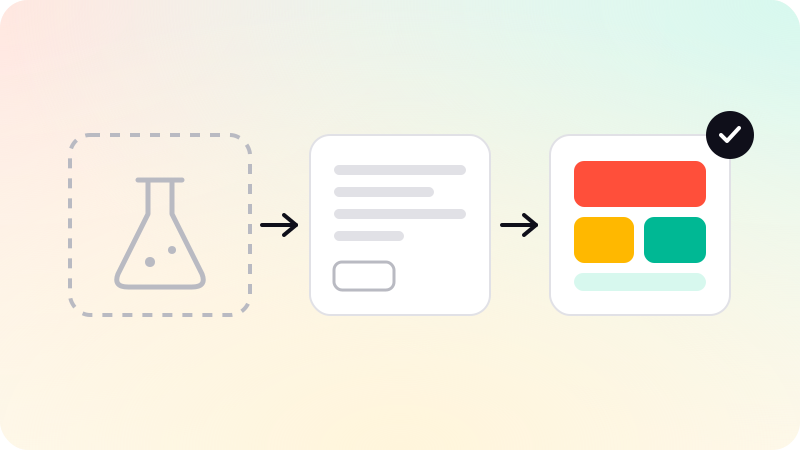
A minimum viable product is the smallest version that lets you learn whether people will use something. A minimum lovable product, or MLP, is the smallest version people will love, not merely tolerate. The two are closer than they sound. The useful lesson of the MLP is that small should not mean poor: do fewer things, and do those few things well.
Key points
- MVP asks: will people use this at all?
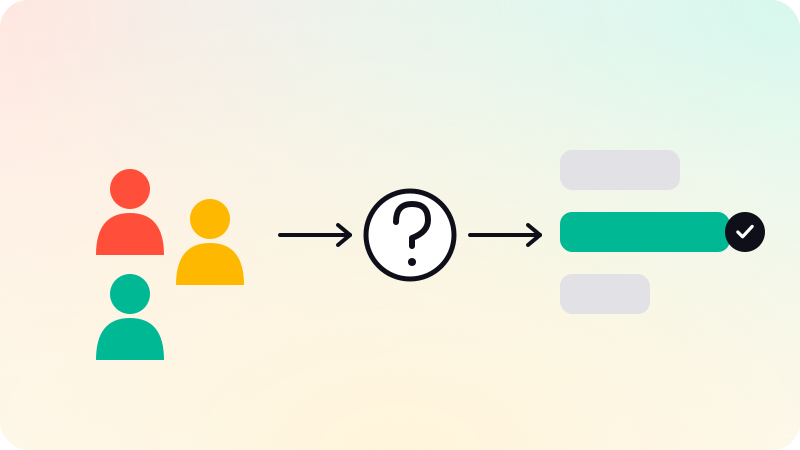
- MLP asks: will the first users love it enough to stay and tell others?
- Both mean a small scope. Neither means low quality.
- In a crowded market, "viable" is not enough to be chosen.
- Pick one job and make it feel finished.
The two ideas
The minimum viable product comes from Eric Ries and The Lean Startup: the version of a product that lets a team learn the most about customers with the least effort. Its purpose is learning.
The minimum lovable product is a later idea, popularized by Brian de Haaff of Aha!, who describes it as the initial offering that users love from the start. Its purpose is to earn loyalty, on the argument that customers now have too many alternatives to stay with something merely adequate.
Side by side
| MVP | MLP | |
|---|---|---|
| Main question | Will anyone use this? | Will the first users love this? |
| Optimizes for | Learning quickly | Delight and retention |
| Scope | As small as will test the idea | As small as can still feel great |
| Risk if overdone | A rough product that misreads real demand | Polishing something nobody wanted |
| Best when | The problem is unproven | The problem is proven and the market is crowded |
Where the MVP idea goes wrong
Minimum viable has often been read as permission to ship something unpleasant. That is a misreading. A product that is slow, confusing or buggy does not test demand fairly, because people may reject the experience and not the idea.
- Viable means it actually solves the problem for the user.
- Cutting scope is the goal. Cutting quality on what remains is not.
- A first version still needs working sign-in, safe data and clear screens.
Where the MLP idea goes wrong
Lovable can become an excuse to keep building. Animation, a tenth settings screen and a perfect onboarding tour all feel like love, and none of them tells you whether the product is wanted.
- If demand is unproven, polish is the most expensive way to find out.
- What users love is usually the core job done well, not decoration.
- A launch that keeps moving is the common symptom.
What to actually do
- Prove the problem first, before any product. See How to validate a startup idea.
- Choose one user and one job. Cut everything else.
- Make that one job feel finished: fast, clear, and reliable.
- Do the rest by hand until someone asks for it.
- Launch to a small group, watch what they do, and let that decide what comes next.
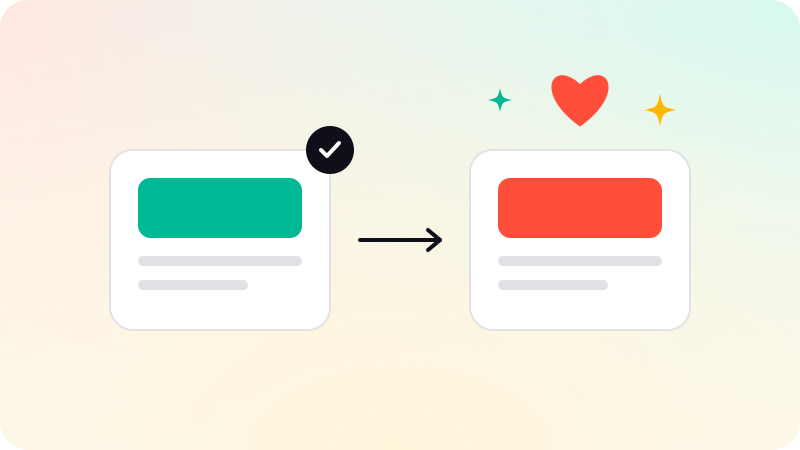
That is an MVP in scope and an MLP in care, and it is the version worth building. The steps are in How to build an MVP, and it is how we approach MVP development: a clickable flow before code, and one job done well.
Sources
Checked when this guide was written.