 BYD Tech
The short answer
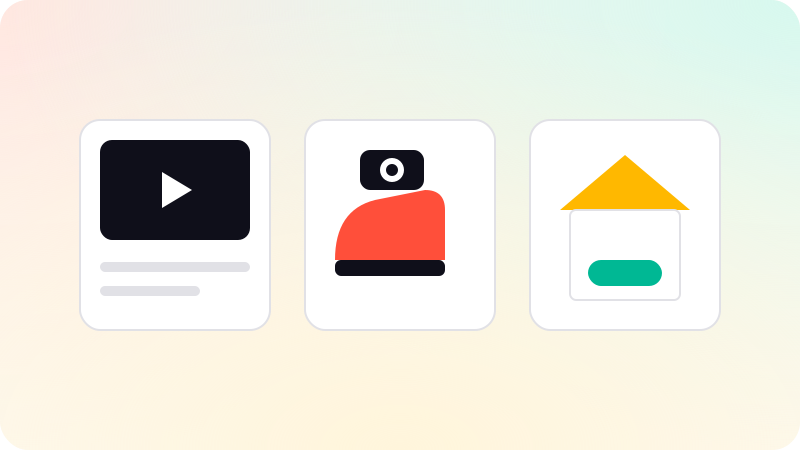
Many well-known companies began with a first version far smaller than people imagine. Dropbox tested demand with a demo video before the product was finished. Zappos tested whether people would buy shoes online by photographing shoes in local stores and buying them only when an order came in. Airbnb’s founders rented air mattresses in their own apartment. Each MVP answered one question as cheaply as possible.
Key points
- An MVP can be a video, a manual service or a single web page.
- Each famous example tested one risky assumption.
- Doing things by hand first is normal, and often smart.
- The examples are about learning, not about copying the format.
- Choose the cheapest test that gives an honest answer.
Dropbox: a video before a product
File syncing that just works is hard to build, and the founders needed to know people wanted it before spending the effort. They made a short video showing how the product would work. Interest from the video, in sign-ups for early access, told them demand was real. Eric Ries tells this story in The Lean Startup as an example of an MVP that is not software at all.
What it tested: do people want this? What it did not test: can we build it? That came next.
Zappos: the shop was a person with a camera
The question was whether people would buy shoes without trying them on. Instead of building a warehouse, the founder photographed shoes in local stores, put them online, and when someone ordered, bought the pair at full price and shipped it. It lost money on each sale and answered the question.
This is the manual approach, sometimes called a concierge or "Wizard of Oz" MVP: the customer sees a product, and people do the work behind it.
Airbnb: air mattresses at home
Airbnb’s own history describes how the founders, short on rent, put air mattresses in their apartment and offered them to visitors during a busy conference. A simple website and a few real guests showed that strangers would pay to stay in someone’s home.
The patterns behind them
| Type of MVP | What it is | Good for testing |
|---|---|---|
| Explainer video or landing page | Shows the product before it exists | Whether people want it |
| Concierge | You deliver the service by hand, openly | What customers actually need |
| Wizard of Oz | Looks automated, people do the work behind it | Whether the experience works |
| Single-feature product | One job, done in real software | Whether people keep using it |
| Clickable prototype | Linked screens, nothing real behind them | Whether the flow makes sense |
Lessons for your first version
- Name the riskiest assumption. That is what the MVP must test.
- Find the cheapest honest test of it. It may not need code.
- Do things by hand that software will do later. Paul Graham’s Do Things That Don’t Scale makes the case.
- Once demand is clear, build the smallest real product, and measure whether people stay.
The differences between these formats are covered in MVP vs prototype vs proof of concept, and building the real first version in How to build an MVP. When the answer is "build it", that is our MVP development work.
Sources
Checked when this guide was written.