 BYD Tech
The short answer
Onshore means a team in your own country, nearshore a team in a nearby country with similar working hours, and offshore a team far away, often with little overlap in the working day. Onshore makes meetings and legal recourse simplest, nearshore keeps shared working hours while widening the choice of people, and offshore widens the choice most but asks for the most deliberate way of working. Whether it works depends less on distance than on written specs, agreed overlap time, code in your own repository and one person who makes decisions.
Key points
- The labels are relative: a nearshore team for one buyer is offshore for another.
- Time-zone overlap shapes how fast decisions get made more than distance does.
- Letting a team abroad work with personal data can be a regulated transfer, even if they only view it remotely.
- Set the governing law, the place for disputes and the ownership of the code in the contract, wherever the team is.
- Compare cost by what gets built and how much managing it takes, not by headline rates.
- Distributed teams work when the work is written down, the code is in your repository, and one person decides.
What onshore, nearshore and offshore mean
- Onshore: the team works in the same country as you, under the same law, usually in the same or a neighboring time zone.
- Nearshore: the team is in a nearby country, with working hours that mostly overlap yours.
- Offshore: the team is far away, often with only a small part of the working day in common.
The terms describe the buyer, not the team. A company in Germany might call a team in Poland nearshore and one in Vietnam offshore. A company in Canada might call a team in Mexico nearshore. A company in Australia might call Southeast Asia nearshore and Europe offshore. The same team in India is nearshore to a buyer in the Gulf and offshore to one in North America.
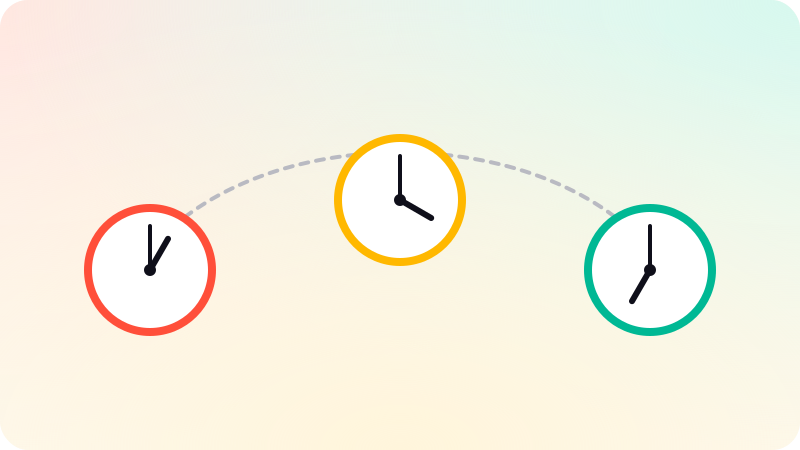
Time zones matter more than distance. A team in a neighboring country can still start and finish its day well before or after yours, while a team much further away, north or south of you, can share almost all of your working day.
Side by side
| Onshore | Nearshore | Offshore | |
|---|---|---|---|
| Where the team is | Your country | A nearby country with similar working hours | A distant country, often working at a different part of the day |
| Time-zone overlap | The whole working day | Most of the working day | Little; calls need an agreed window |
| Meetings | Any time, and in person is easy | Easy to schedule, short trips | Planned in advance, mostly by video |
| Communication | Usually the same language and business habits | Often similar habits; language varies | Works best in writing; habits vary more |
| Contracts and disputes | Your own law and courts | Cross-border; choose the law and the forum in the contract | Cross-border; choose the law and the forum, and consider arbitration |
| Personal data | Usually no international transfer | May be a transfer, depending on the countries | Often a transfer that needs a lawful mechanism |
| Cost structure | Usually the highest local rates | Usually in between | Usually the lowest rates, with more effort spent on coordination |
| Talent pool | Limited to your local market | Wider | Widest |
| Main risk | Cost, and competing with larger employers to hire | Assuming closeness replaces a clear process | Slow decisions and gaps in the specs |
Time zones, meetings and communication
Overlap decides how quickly a question becomes an answer. With a shared working day, a developer who is unsure asks and carries on. With little overlap, an unclear spec can stall work until the other side wakes up, or worse, the developer guesses. The fix is not more meetings; it is fewer open questions, because the work was written down before it started.
- Agree a window for calls that is reasonable at both ends, and use it for decisions and questions rather than status reports.
- Check public holidays and working weeks on both sides; they differ between regions.
- Ask the team to raise problems in writing as soon as they see them. In some working cultures people hesitate to say no or to report bad news, so make it clear that early warnings are welcome.
- Use one shared place for decisions and questions, not scattered chats, so nothing depends on who was on which call.
Contracts, IP and data protection
Across borders, the contract should say which country’s law applies and where disputes are settled. A court judgment from your country can be hard to enforce where the team is. Arbitration is one answer: under the New York Convention, which more than 170 states have joined, courts in member states recognize and enforce foreign arbitral awards much as they would domestic ones.
Ownership of the code comes from the contract and the law, not from where the team sits. Get a written assignment of the intellectual property to your company, and keep the repository and every account in your company’s name from day one. The details are in Who owns the code when you hire a developer or agency?.
If the product handles personal data about people in the EU or the UK, letting a team in another country work with it can be a regulated international transfer. The European Commission explains that the GDPR requires safeguards so that protection travels with the data. Transfers to a country the Commission has found adequate need no further safeguard; otherwise a tool such as the Commission’s standard contractual clauses is used.
The UK ICO applies the same idea under UK GDPR, with its own adequacy regulations and safeguards such as the international data transfer agreement, plus a transfer risk assessment when you rely on a safeguard. The ICO counts making data accessible to a separate organization abroad as a transfer, not only sending it, so a team that only views your database remotely is covered. Other countries have their own rules, so check the ones that apply where your users are.
The simplest way to shrink the problem is to keep real personal data out of development. Build and test with made-up data, and give an outside team access to live data only where the work needs it.
Cost structure and talent
Rates differ widely between regions, but the rate is only part of the total. What you get for the money is what gets built, and what it takes to manage it. A distant team with lower rates can cost more overall if specs are vague and every decision waits on the other side of the world. A local team can cost less than it looks if it needs less direction. Count the time your own people will spend writing specs, answering questions and reviewing work, and the rework if something is misunderstood.
Looking further widens the pool of people. A local market may have few people with a particular skill, such as mobile, AI or a specific industry, and those it has are in demand. Nearshore and offshore let you choose by skill and fit first. Judge any team the same way, by how it works: How to choose a software development company has the questions to ask.
How to make a distributed team work
- Write the specs down. Each feature gets a short description of who it is for, what it does and how you will know it works. How to write user stories shows a format.
- Agree an overlap window for calls and keep it for decisions and questions.
- Run updates in writing: what was done, what is next, what is blocked. A written update can be read at the start of your day, whatever the time zone.
- Keep the code in your company’s repository from day one, with the team added as members, so progress shows in the commits and nothing sits on someone else’s machine.
- Name one decision-maker on your side whose answer is final. Two people giving different answers costs more across time zones than in one room.
- Record important decisions and their reasons in the repository, so a newcomer or a later team can follow them.
- Start with a small, well-defined piece of work to test the way of working before committing to a large one.
If the relationship ends, a clean handover depends on the same habits; How to take over a project from a freelancer has a checklist that applies to any outside team.
How to choose
- Choose onshore when the work needs frequent in-person contact, when a contract or regulator requires a local team, or when the data must stay in the country.
- Choose nearshore when shared working hours matter and you want a wider choice of people than your local market offers.
- Choose offshore when skills and fit matter more than overlap, and you are ready to work in writing.
- Whichever you choose, the same conditions decide the outcome: written specs, code you own, personal data handled lawfully, and one decision-maker.
BYD Tech’s team is in India and sets call times around each client’s working day; the founders are on every call, and the code lives in the client’s GitHub from day one. Web app development describes how a project starts.
Sources
Checked when this guide was written.
- European Commission: Rules on international data transfers
- European Commission: Adequacy decisions
- European Commission: Standard contractual clauses (SCC)
- ICO: A brief guide to international transfers
- UNCITRAL: Convention on the Recognition and Enforcement of Foreign Arbitral Awards (New York, 1958)
- UNCITRAL: Status of the New York Convention