
 BYD Tech
The short answer
A multi-agent system is an AI setup where several agents work on one job, usually a lead agent that plans and hands parts of the work to helper agents that run in parallel. It helps most on broad tasks that split into independent pieces, such as research across many sources. It costs much more: Anthropic reported its multi-agent research system used about 15 times the tokens of a chat. For tasks with tight dependencies, including most coding, one well-built agent is usually better.
Key points
- A lead agent plans; helper agents work on independent pieces in parallel.
- Best for broad tasks that split cleanly, such as research.
- Expect far higher token costs than a single agent.
- Poor fit when every step depends on the last, or all agents need the same context.
- Start with one agent, and split only when you can measure the gain.
What a multi-agent system is
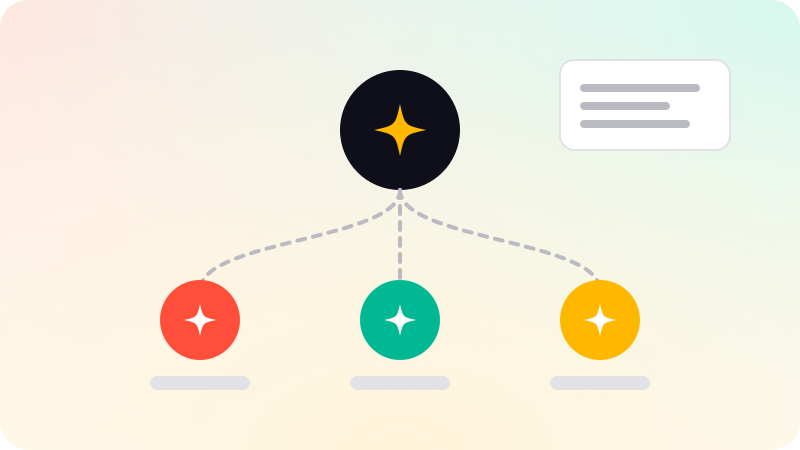
A single AI agent is a model working in a loop: it decides on a step, uses a tool, looks at the result and decides again. See What is an AI agent?. A multi-agent system runs several of these loops together. The most common shape is orchestrator and workers: one lead agent breaks the task down, starts helper agents for each part, and combines what they return.
Each helper gets its own context window, so together they can look at far more material than one agent could hold at once.
What the evidence says
In June 2025 Anthropic described the multi-agent research system behind Claude’s Research feature. On its internal research evaluation, a lead agent with helper agents outperformed a single agent by 90.2 percent. The same write-up reports that agents use about 4 times the tokens of chat, and multi-agent systems about 15 times.
It also names where the approach fits poorly: tasks where all agents need the same context, tasks with many dependencies between agents, and most coding tasks, which have fewer truly parallel pieces than research.
One agent or several?
| Situation | Better fit |
|---|---|
| Research across many sources | Several agents |
| Comparing many options in parallel | Several agents |
| Step-by-step task where each step needs the last | One agent |
| Editing one codebase | Usually one agent |
| Low-value, high-volume requests | One agent, for cost |
| Separate specialists with different tools and permissions | Several agents, or one agent with clear tool limits |
Building one well
- Give each helper a clear task, the output format you need, and limits on how much work to do.
- Keep the lead agent responsible for the final answer and for checking helpers’ results.
- Log every agent’s steps so a failure can be traced.
- Set token and time limits per run.
- Measure against a single-agent baseline. See How to evaluate AI agents.
Agents built by different teams or vendors can also talk to each other through open protocols. See What is the A2A protocol?. Single agents and multi-agent setups are both part of AI agent development.
Sources
Checked when this guide was written.


