 BYD Tech
The short answer
To get a new website indexed by Google, make sure pages are crawlable and not blocked, add the site to Google Search Console, submit an XML sitemap, link to the site from places Google already crawls, and request indexing for your most important pages with the URL Inspection tool. Google says it does not guarantee that any page will be crawled or indexed, and new sites often wait days or weeks. Pages with thin or duplicate content may be crawled but left out.
Key points
- Crawling, indexing and ranking are separate stages.
- Search Console and a sitemap tell Google what exists.
- URL Inspection can request indexing for key pages, within a daily limit.
- Google does not guarantee indexing, especially for thin pages.
- Patience: new sites commonly take days to weeks.
How Google finds pages
| Stage | What happens |
|---|---|
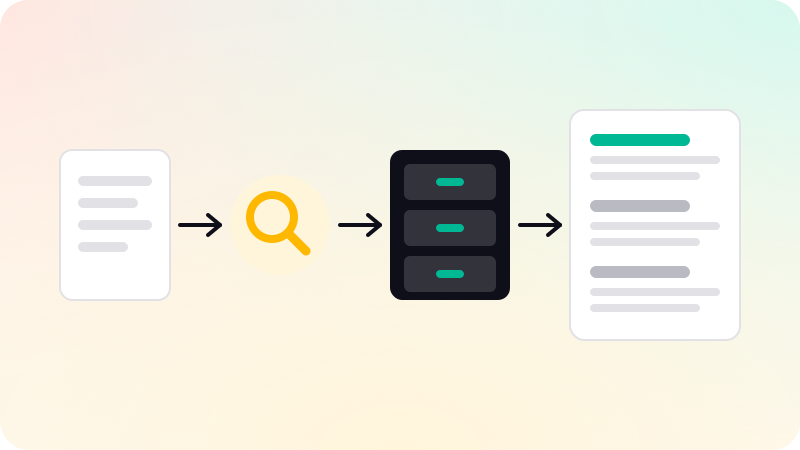
| Crawling | Google’s crawler discovers the URL and downloads the page |
| Indexing | Google analyzes the content and may store it in its index |
| Serving | Indexed pages can appear in results for relevant searches |
Google’s own guide is explicit that it does not guarantee it will crawl, index or serve a page, even one that follows its guidelines, and that not every page it processes is indexed.
The steps
- Check robots.txt and meta tags do not block crawling or indexing.
- Verify the site in Google Search Console, ideally as a domain property.
- Submit your XML sitemap in Search Console.
- Make sure every important page is linked from your navigation or other pages.
- Use URL Inspection to request indexing for your home page and key pages. There is a daily limit.
- Get links from places Google already crawls: your profiles, directories, partners.
When pages stay out
| Search Console status | Usual meaning |
|---|---|
| Discovered, currently not indexed | Google knows the URL but has not crawled it yet; common on new sites |
| Crawled, currently not indexed | Google read it and chose not to index it, often for thin or similar content |
| Duplicate without user-selected canonical | Google sees it as a copy of another page |
| Excluded by noindex tag | The page tells Google not to index it |
| Blocked by robots.txt | Crawling is not allowed |
Publishing many similar pages at once on a new site can slow things down: Google may index a few, judge the rest similar, and wait. Fewer, clearly useful pages are indexed more reliably than many thin ones.
Beyond Google
Bing Webmaster Tools works the same way, and also supports IndexNow, a protocol that notifies participating search engines when pages change. A full technical review is in Technical SEO checklist, and structured data in Schema markup guide. Crawlable, indexable sites are part of our website development work.
Sources
Checked when this guide was written.