 BYD Tech
The short answer
A usability test means watching people who match your users try to complete real tasks with your product or prototype, while you observe where they struggle. You need three things: a facilitator, realistic tasks and representative participants. Jakob Nielsen’s well-known analysis found that five users in one round uncover most usability problems, so it is better to run several small rounds, fixing issues in between, than one large study.
Key points
- Watch people do real tasks. Do not ask what they think they would do.
- Five users per round finds most problems, if they are similar users.
- Run small rounds often, fixing between them.
- Do not help participants. Their struggle is the finding.
- Test prototypes early, when changes are cheap.
What a usability test is
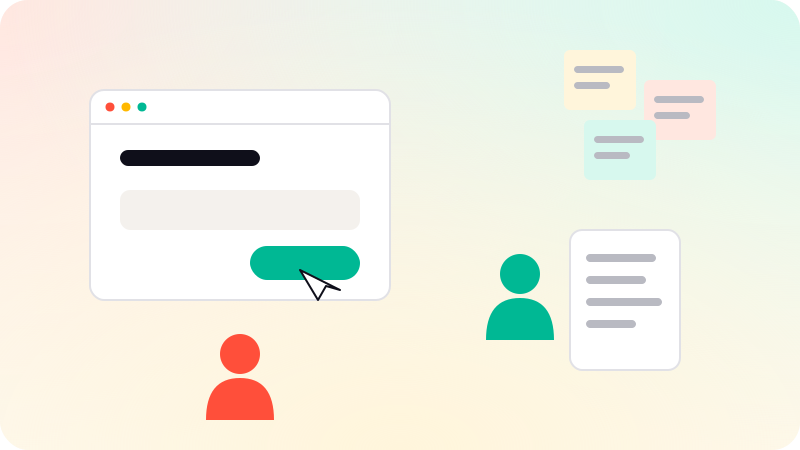
The Nielsen Norman Group describes a usability test as a facilitator asking a participant to perform tasks with an interface while observing their behavior and listening for feedback. It is about what people do, not what they say they like. A person can say a design looks great and still fail to find the checkout button.
How many users you need
In 2000, Jakob Nielsen published an analysis showing that a first round with five participants finds about 85 percent of usability problems, with fewer new findings from each additional person. He recommends several small rounds instead of one big one, because fixes can introduce new problems and deeper issues appear once surface ones are gone.
- The five-user rule assumes similar users. For distinct groups, such as buyers and sellers, test a few from each.
- Quantitative studies, which measure success rates or times, need more participants.
- Testing with one person is not enough: anyone can behave unusually.
Running a test
- Pick the questions you need answered, such as "can new users sign up and create their first project?"
- Write realistic tasks without hints in the wording.
- Recruit participants who match your users, not colleagues.
- Ask them to think aloud as they work.
- Stay quiet. If asked for help, reply with a question: "What would you do if I were not here?"
- Record the session, with permission, and note where people hesitate, err or give up.
Remote tests over a video call work well and make recruiting easier. Moderated tests let you ask follow-up questions; unmoderated tools let participants work alone at their own time.
Turning findings into fixes
- List each problem with how many participants hit it and how badly.
- Fix the problems that stop people completing tasks first.
- Test again with new participants to confirm the fix worked.
Usability testing fits the prototype and test stages of The design thinking process, and a review of a live product is a UX audit. Clickable prototypes you can test before anything is built are part of our UI/UX design work.
Sources
Checked when this guide was written.